
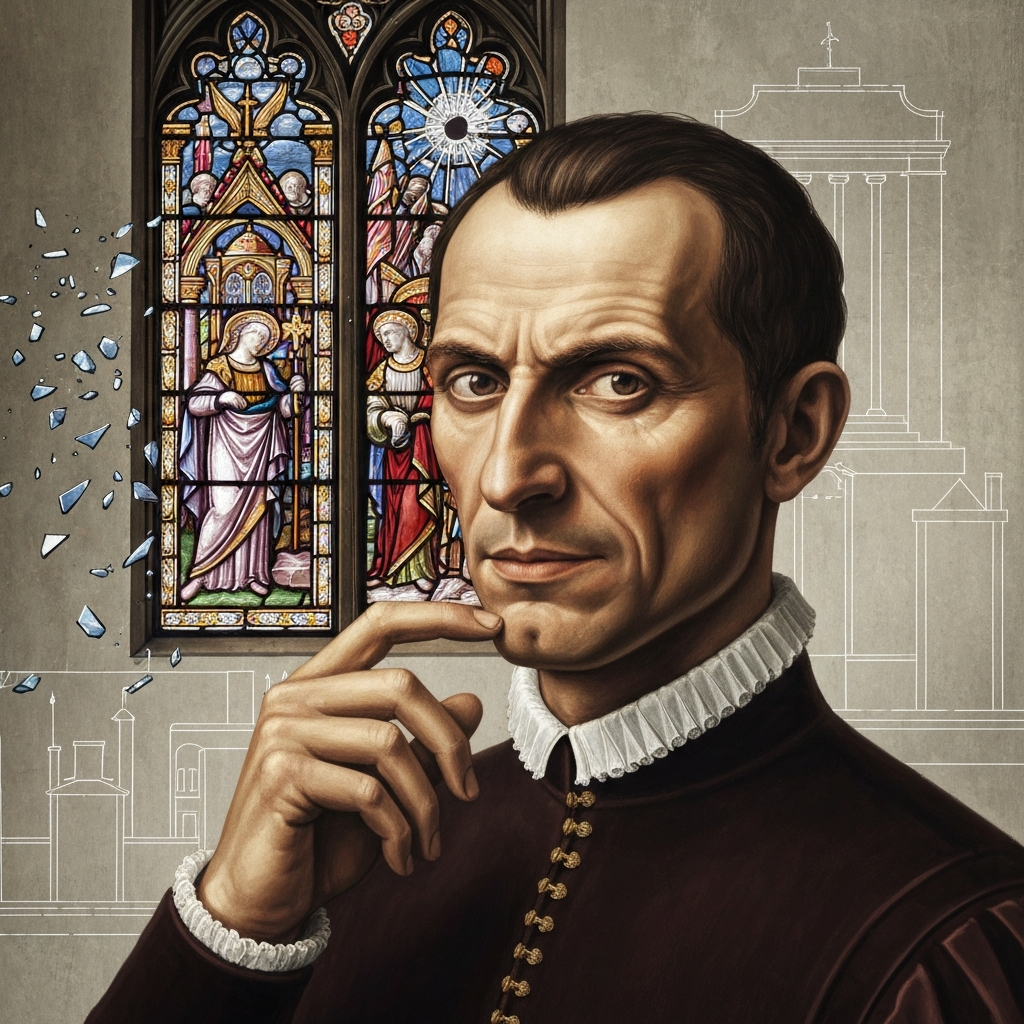
The Architecture of Power: Machiavelli, The Prince, and the Subversion of the Medieval Order
Niccolò Machiavelli's 'The Prince' is more than a manual for tyrants; it's a revolutionary philosophical text that shattered medieval thought and laid the groundwork for modern political realism.
Listen to this article
Chapters
22 min listen
The Architecture of Power: Machiavelli, The Prince, and the Subversion of the Medieval Order
The name Machiavelli has transcended its historical origins to become a culturally ubiquitous adjective, universally synonymous with political deceit, ruthless ambition, and the instrumentalization of human life. Yet, this superficial reduction of Niccolò Machiavelli to a mere caricature of autocratic malice obscures one of the most profound epistemological ruptures in the history of Western political thought. Far from being a simple, uncritical instruction manual for aspiring tyrants, The Prince (De Principatibus) is a remarkably complex and deeply contested treatise. Beneath its pragmatic surface, the text operates as a devastating deconstruction of the prevailing religious and social norms of the sixteenth century, an esoteric intervention steeped in classical materialism, and a foundational document in the creation of political modernity. To fully comprehend the architecture of modern power, it is imperative to dismantle the mythologies surrounding Machiavelli and examine the chaotic geopolitical crucibles, the radical philosophical influences, and the fiercely debated subversive intents that forged his most infamous work.
The Geopolitical Crucible: Fragmentation and Foreign Domination
The genesis of The Prince cannot be decoupled from the profound political and geographical fragmentation of the Italian peninsula during the fifteenth and sixteenth centuries. Unlike the centralizing, increasingly robust nation-states of France, Spain, and England, Italy was a deeply fractured patchwork of fiercely competitive city-states, republics, and papal territories. This endemic geopolitical disunity, characterized by shifting alliances and a reliance on unreliable mercenary armies, rendered the peninsula exceptionally vulnerable to foreign intervention.
This vulnerability was exposed with catastrophic clarity in 1494 when King Charles VIII of France invaded Italy. Motivated by dynastic claims to the Kingdom of Naples and supported by the vast, centralized resources of the French state, Charles VIII’s invasion shattered the fragile diplomatic equilibrium that had previously been maintained by figures like Lorenzo the Magnificent. The French incursion marked the beginning of the Italian Wars, a protracted period of continent-wide conflict spanning from 1494 to 1559, during which Italy was transformed into the "cockpit of Europe"—the primary theater for the geopolitical rivalry between the French Valois and the Spanish-Austrian Habsburg dynasties. This era of relentless warfare and foreign domination demonstrated the advent of a sophisticated, modern system of military expansion and balance-of-power diplomacy, deeply entangling Italy in a web of European ambitions.
For Machiavelli, the harrowing spectacle of his homeland—a region he would later describe as "desperate, more enslaved than the Hebrews, more oppressed than the Persians, more displaced than the Athenians, looted and ravaged"—served as the primary catalyst for his political theories. He recognized with chilling clarity that the survival of any Italian state in this new era required not just traditional, localized diplomacy, but centralized executive power, a loyal citizen militia, and an acute understanding of international realpolitik.
| Historical Event | Date | Geopolitical Consequence for Italy and Florence |
|---|---|---|
| Invasion by Charles VIII of France | 1494 | Shattered the Italian balance of power; triggered the expulsion of the Medici from Florence and the establishment of the Florentine Republic. |
| Machiavelli Enters Public Service | 1498 | Appointed to the Second Chancery; begins observing the mechanisms of international diplomacy and warfare firsthand. |
| The Holy League Expels France | 1512 | Initiated by Pope Julius II; led to the collapse of the Florentine Republic, the return of the Medici, and Machiavelli’s dismissal from office. |
| Sack of Rome by Charles V | 1527 | Demonstrated the ultimate failure of Italian defense; resulted in the temporary expulsion of the Medici and Machiavelli's death shortly after. |
Machiavelli’s personal and professional trajectory was inextricably linked to the turbulent fortunes of Florence amidst this continental crisis. The French invasion of 1494 catalyzed the overthrow of the ruling Medici family, leading to the establishment of a Republic. It was within this newly formed republican government that Machiavelli entered public service in 1498, eventually becoming the Second Chancellor and gaining unparalleled experience as a diplomat and military strategist over the course of fourteen years.
During his tenure, Machiavelli undertook critical diplomatic missions that deeply informed the political philosophy later codified in his writings. He spent time at the French court, observing the strategic blunders of King Louis XII, whom he later criticized for committing capital errors in statecraft that ultimately led to his expulsion from Italy. More crucially, Machiavelli was dispatched to the papal court in Rome, where he witnessed the meteoric rise and ruthless operational tactics of Cesare Borgia, the illegitimate son of Pope Alexander VI. Borgia, who abandoned an archbishopric at age seventeen to aggressively conquer territories in the Romagna, became Machiavelli’s primary archetype of a "new prince"—a ruler who utilized violence, deception, and strategic alliances to consolidate state power in a chaotic environment.
The republican era of Florence came to a disastrous end in 1512. Following the formation of the Holy League by Pope Julius II, French forces were driven from Italy, leaving Florence uniquely vulnerable to papal retribution. The Republic fell, the Medici were restored to power with the backing of Spanish troops, and Machiavelli was summarily dismissed from his posts. Shortly thereafter, falsely implicated in an anti-Medici conspiracy, he was imprisoned, tortured, and subsequently exiled to a small farmhouse outside the city.
It was during this period of forced isolation, political impotence, and near-poverty, beginning in 1513, that Machiavelli authored The Prince. Originally titled De Principatibus (Of Principalities), the manuscript was explicitly dedicated to Lorenzo de' Medici in a desperate, yet ultimately unsuccessful, bid to ingratiate himself with the new rulers and secure a return to public service. Despite its dedication, historical evidence suggests the Medici never even read the work, and Machiavelli remained largely marginalized until his death in 1527, mere weeks after the Medici were once again expelled from Florence and the Republic briefly restored. Ironically, the very existence of the book, which was viewed as a manual for maintaining autocratic power, later prevented Machiavelli from being accepted by the republicans who regained control of Florence.
Rupturing the Medieval Paradigm: The Rejection of Natural Law
The historical significance of The Prince derives primarily from its violent epistemological break with medieval political philosophy. Prior to Machiavelli, the dominant mode of political writing was the specula principum, or "Mirror of Princes" genre, which instructed rulers to cultivate classical and Christian virtues—such as piety, clemency, charity, and honesty. This tradition operated under the fundamental assumption that moral goodness inherently produced political stability and that earthly governance must reflect divine justice.
This teleological worldview was heavily rooted in the theology of Thomas Aquinas, who posited that human law and political order must be a direct reflection of a divinely ordained Natural Law. For Aquinas, the universe was ordered by divine design, and a ruler’s legitimacy was inextricably tied to their adherence to objective moral truths and their orientation toward the common good and spiritual salvation.
Machiavelli categorically rejected this teleological worldview. Where Aquinas saw divine order, Machiavelli saw natural chaos; where the medieval tradition saw the necessity of moral purity, Machiavelli saw the primacy of human agency and coercive power. He explicitly critiqued utopian theorizing, stating his intent to write something "useful" by focusing on the "effectual truth" (verità effettuale) of politics rather than the imagination of it. By asserting that "a man who wishes to make a profession of goodness in everything must necessarily come to grief among so many who are not good," Machiavelli systematically stripped politics of its religious pretensions and declared its absolute autonomy from traditional ethics.
| Conceptual Pillar | Thomistic Medieval Framework (Natural Law) | Machiavellian Political Realism |
|---|---|---|
| Foundation of Authority | Derived from Divine and Natural Law; legitimate only if moral. | Derived from coercive force and power; whoever has power has the right to command. |
| Ultimate Goal of Leadership | Moral virtue, justice, and the spiritual salvation of subjects. | The acquisition, maintenance, and security of the state (mantenere lo stato). |
| Cosmological View | A divinely endowed, teleological order designed by God. | A chaotic, material world governed by the unpredictable physics of fortune. |
| Ethical Imperative | Absolute adherence to objective moral virtues and Christian teachings. | The flexibility to "enter into evil" when strategically necessary for state survival. |
Central to Machiavelli's epistemological shift is his radical redefinition of virtù. In the classical and medieval traditions, virtue denoted moral goodness and adherence to Christian ethics. Machiavelli’s virtù, however, is derived from the Latin vir (man) and denotes martial prowess, operational skill, excellence, self-reliance, and strategic foresight. It is the capacity to shape reality through sheer force of will and independence, relying on "one's own arms" rather than the arms of others. A prince possessing Machiavellian virtù does not blindly follow moral dictates; rather, he possesses the flexibility to know when to utilize traditional virtues and when it is strategically necessary "not to be good". Seeming vices, such as cruelty, can be "well-used" if they secure the state and prevent greater bloodshed, while apparent virtues, such as excessive mercy, can lead to ruin if they allow political disorder to fester.
This newly defined virtù operates in constant, dynamic tension with Fortuna (Fortune). Machiavelli views fortune not as divine providence guiding human destiny, but as a chaotic, unpredictable force. In Chapter 25 of The Prince, he famously likens fortune to "one of those violent rivers" that, when enraged, floods plains and uproots everything in its path. While the river’s destructive power cannot be wholly eliminated, a ruler with virtù builds dams and dikes during times of peace to channel and mitigate its fury. Furthermore, Machiavelli employs highly aggressive, gendered imagery, describing fortune as a fickle woman (una donna) who must be "beaten and struck" to be subdued, favoring the impetuous and the bold over the cautious. This formulation completely removes God from the equation of human success; human destiny is no longer a matter of spiritual predestination, but a violent negotiation between human capability and the chaotic physics of circumstance.
The Lucretian Turn: Atomism, Materialism, and the Atheist Critique
The removal of divine providence from Machiavelli's political theory was not merely a pragmatic choice, but a deeply philosophical one, rooted in his clandestine engagement with ancient materialism. The rediscovery of the Roman poet Lucretius’s Epicurean masterpiece, De Rerum Natura (On the Nature of Things), profoundly influenced Renaissance humanist circles, and Machiavelli’s own handwritten transcription of the poem, complete with marginalia, confirms his intense study of its atomistic principles.
Lucretius posited an atomistic universe governed entirely by the physical motion of matter in a void, explicitly denying divine intervention, teleology, or the immortality of the soul. The primary ethical goal of Lucretian Epicureanism was to free humanity from the paralyzing fear of the gods and the afterlife. Machiavelli absorbed this materialist cosmology but fundamentally altered its political application. While Lucretius advocated for withdrawing from public life to achieve tranquil peace (ataraxia), Machiavelli recognized that human affairs are constantly in motion and that political conflict is inescapable.
Machiavelli weaponized Epicurean materialism to construct a wholly secular statecraft. If the universe is merely matter in motion, devoid of a divine judge, then religion is not a transcendent truth but a sociological phenomenon. Machiavelli recognized that while the fear of the gods was ontologically baseless, it was politically indispensable. He advocated using the utility of religious belief—specifically the fear of divine punishment—to establish social order and enforce laws, effectively utilizing religion "in the service of politics and not as its master". By substituting the paralyzing fear of an unpredictable nature with the engineered fear of the prince, Machiavelli sought to guarantee the security of the state in a chaotic cosmos, replacing the religious pursuit of tranquility with the secular pursuit of security.
This instrumentalization of religion and his materialist foundations have led to a longstanding scholarly debate regarding his alleged atheism. The philosopher Leo Strauss provides one of the most comprehensive arguments for viewing The Prince as an intentionally anti-Christian, atheist text. In his work Thoughts on Machiavelli, Strauss argues that Machiavelli wrote esoterically, employing a "peculiar rhetoric" and presenting his true thoughts in an "oblique way" to bypass the severe restrictions on freedom of speech imposed by the Church.
Strauss contends that the apparent contradictions in Machiavelli's works—such as alternating between praising piety and advocating cruelty—are deliberate rhetorical strategies designed to confuse the superficial reader while signaling the attentive one. By occasionally "playing the fool" and adopting orthodox opinions he knew to be false, Machiavelli shielded his more radical teachings. Central to this hidden teaching is a devastating critique of Christianity. Machiavelli argued that conventional Christian virtues—humility, meekness, and a focus on the afterlife—had "disarmed heaven," made the world "effeminate," and rendered citizens unwilling to fight for their earthly fatherland.
In contrast, Machiavelli highly praised the civic religions of ancient pagan societies, particularly the Roman Republic, which utilized auguries and rituals not to prepare for the afterlife, but to inspire martial valor, patriotism, and social cohesion in the present. Strauss notes that Machiavelli deliberately subverted the Christian historical timeline; while Christian tradition viewed the reign of Augustus (under whom Jesus was born) as a peak of justice, Machiavelli characterized it as a period of utter corruption where the people were rendered "unarmed". Ultimately, Strauss concludes that Machiavelli was "too thoughtful not to know what he was doing"; he was the mastermind behind a philosophical conspiracy to break Christianity's hold on political life and replace it with a true normative teaching based solely on earthly power and human necessity.
The Politics of Deception: Subversion and the Republican Trap
The traditional, orthodox reception of The Prince interprets the text as a sincere, if morally abhorrent, instructional manual for despots—a view that eventually led the Catholic Church to place it on the Index Librorum Prohibitorum in 1559, and prompted early modern critics, such as Innocent Gentillet, to coin the term "Machiavellianism" as a synonym for state-sanctioned evil and hold Machiavelli morally responsible for atrocities like the St. Bartholomew's Day massacre. However, this orthodox interpretation has long been fiercely contested by an alternative scholarly tradition that views the text as fundamentally subversive, satirical, and inherently republican.
During the Enlightenment, philosophers such as Denis Diderot and Jean-Jacques Rousseau argued that Machiavelli’s true intent was to expose the viciousness of tyrants to the masses. Rousseau famously declared in The Social Contract that Machiavelli "was a proper man and a good citizen" who, "being attached to the court of the Medici, he could not help veiling his love of liberty in the midst of his country's oppression". For Rousseau, The Prince was not a manual for tyrants, but rather "the book of republicans," designed to reveal the mechanics of oppression so that citizens might recognize and resist it.
Modern scholars have significantly expanded upon this subversive interpretation, moving beyond Rousseau's view of the text as a simple exposé. The most compelling and rigorous iteration of this theory is advanced by Mary G. Dietz in her seminal essay "Trapping the Prince". Dietz posits that The Prince is a "masterful act of political deception". According to this framework, Machiavelli’s underlying intention was fiercely republican; his goal was not to aid Lorenzo de' Medici, but to deliberately engineer his downfall and facilitate the return of the Florentine Republic.
Dietz argues that Machiavelli utilized his sophisticated understanding of political strategy to offer advice that appeared sound on the surface but was, in the specific context of sixteenth-century Florence, actively suicidal for an autocratic ruler. Specifically, Machiavelli advises the prince to physically reside in the conquered city and to actively arm the local populace. In a city like Florence, which possessed a deeply ingrained republican culture and a populace that had recently demonstrated its willingness to overthrow tyrants, following this advice would virtually guarantee armed rebellion and the prince's assassination. By advising the Medici to "play the fox" while simultaneously handing the weapons of the state over to an aggrieved, anti-Medicean citizenry, Machiavelli was, in Dietz's view, setting a lethal trap masquerading as loyal counsel. He intended for a gullible and vainglorious prince to heed duplicitous advice, taking actions that would jeopardize his power and bring about his ultimate demise.
The subversive nature of The Prince is perhaps most transparently on display in Chapter 11, "Of Ecclesiastical Principalities." Here, Machiavelli addresses the territories governed by the Catholic Church. On the surface, he adopts a tone of pious reverence, stating that these states are "won by prowess or by fortune but are kept without the help of either," because they are sustained by ancient religious institutions and "higher causes" that the human mind cannot fathom. Because they are established and maintained by God, he writes, it would be "the work of a presumptuous and foolhardy man to discuss them".
Yet, having made this deferential disclaimer, the chapter immediately pivots into a cold, devastatingly analytical deconstruction of the political and military maneuvers the Church used to consolidate its temporal power. Machiavelli meticulously details how figures like Pope Alexander VI and Pope Julius II utilized armed force, factional manipulation, the accumulation of wealth, and strategic alliances to conquer Italian territories, behaving identically to secular warlords. This juxtaposition—claiming divine protection while explicitly documenting ruthless political violence—is widely interpreted as a masterpiece of anti-ecclesiastical irony and satire. It exposes the blatant hypocrisy of the Church and demonstrates that even supposed divine authority requires brutal operational strategy to survive the human field; as Machiavelli implies, God may crown a ruler, but men still conspire, and mystique is not a moat unless it is paired with machinery.
Gramsci, the Modern Prince, and the Standardization of the Masses
In the twentieth century, the Marxist theorist Antonio Gramsci offered yet another radical reinterpretation of Machiavelli’s intended audience and historical purpose. Writing from a fascist prison, Gramsci argued that Machiavelli's audience was not the ruling class, who were already intimately familiar with the machinations of power through their aristocratic education and lived experience. Instead, Gramsci conceptualized The Prince as an early manifesto for mass political organization aimed directly at the common people.
In Gramsci's theoretical framework, outlined in his Prison Notebooks, the "Prince" is not a historical individual, a heroic despot, or even a specific archetype. Rather, the Prince is an organizational metaphor. "The modern prince, the myth-prince, cannot be a real person, a concrete individual," Gramsci wrote; "It can only be an organism, a complex element of society in which a collective will... begins to take concrete form. This organism is already given by historical development; it is the political party".
Gramsci saw Machiavelli as an intellectual seeking to forge a "collective will" among the fragmented Italian populace, attempting to inform the uninformed and galvanize the "revolutionary class of the time, the Italian 'people'". By stripping away the moralistic illusions of power and exposing the brutal realities of statecraft, Machiavelli provided the necessary theoretical tools for the masses to understand how hegemony is constructed and maintained. For Gramsci, Machiavelli's work was a necessary historical phase linked to the "standardization of broad masses of the population," teaching the oppressed the very methods required to build a counter-hegemonic political party capable of seizing and maintaining state power.
The Genesis of Political Realism and the Architecture of the Secular State
Regardless of whether one interprets The Prince through the lens of a republican trap, a Marxist manifesto for collective action, or a Straussian exercise in esoteric atheism, its enduring legacy lies in its role as the foundational text of modern political realism and the secular state. Machiavelli achieved what no thinker before him had dared: the complete, unapologetic conceptual separation of political authority from moral legitimacy.
In the Machiavellian paradigm, authority and power are strictly coequal; the mere possession of power grants the right to command. He systematically demolished the medieval notion that "legitimate rights" or moral goodness could sustain a ruler. Instead, he introduced the concept of the state as an impersonal entity characterized by a monopoly on coercive force within a defined territorial boundary. He argued unequivocally that valid law rests entirely upon the threat of violence, famously asserting that "since there cannot be good laws without good arms, I will not consider laws but speak of arms". This sobering assessment led to his infamous, yet logically consistent, conclusion that it is better for a ruler to be feared than loved, as fear is sustained by a dread of punishment that never fades, rendering it a far more reliable tool for governance than the fickle, self-interested nature of human affection.
The shockwaves generated by this political realism reverberated profoundly through the subsequent centuries of Western political philosophy, decisively shaping the Enlightenment and the architecture of the modern secular state. Thinkers who ostensibly rejected Machiavelli's apparent amorality nevertheless built their frameworks directly upon his empirical, analytical foundations.
The seventeenth-century philosopher Baruch Spinoza deeply integrated Machiavellian realism into his own political writings, particularly the Political Treatise. Spinoza explicitly echoed Machiavelli’s critique of utopian theorizing right at the outset of his work, agreeing that philosophers who construct imaginary republics fail to understand human psychology, and praising statesmen who deal with the realities of power. Spinoza utilized Machiavelli’s insights on the balance of power, the necessity of keeping pacts based on utility rather than morality, and the management of competing social factions to formulate his own constitutional theories.
Similarly, the secularization of political thought advocated by Enlightenment luminaries such as Thomas Hobbes, John Locke, Montesquieu, and David Hume owes a massive, if sometimes unacknowledged, debt to the Florentine secretary. Hobbes’s Leviathan, which bases the commonwealth not on divine right or natural moral law, but on the absolute necessity of coercive force to curb the violent reality of human nature, is a direct, logical descendant of Machiavellian political science. Montesquieu and Hume utilized Machiavelli’s empirical, observational approach to history to derive secular laws of political behavior, prioritizing observable phenomena over theological dictates. By aggressively severing the link between heavenly mandates and earthly governance, and by analyzing politics exactly as it is rather than as it should be, Machiavelli effectively cleared the intellectual terrain for the social contract, the separation of church and state, and the empirical study of international relations.
The Enduring Implications of the Machiavellian Paradigm
The genius of The Prince resides not in its prescription of cruelty, but in its unparalleled diagnostic clarity. By stripping away the theological and moralistic veneers that had historically obscured the mechanisms of power, Machiavelli exposed the raw, structural realities of human governance. He revealed that all political orders, regardless of their ideological justifications, democratic pretensions, or divine claims, fundamentally rely on the management of force, the strategic deployment of fear, and the perpetual negotiation with an unpredictable, material reality.
As contemporary societies navigate the complexities of algorithmic governance, the decline of international institutional norms, and the resurgence of autocratic populism, the foundational questions raised by The Prince remain acutely unresolved. The text forces a continuous confrontation with the tension between the ethical aspirations of a republic and the coercive mechanisms required to sustain it against internal faction and external threat. If the architecture of the modern state is built upon the Machiavellian premise that power is its own ultimate justification, the critical inquiry for future political frameworks is not how to eradicate the realities of power, but how to architect institutions robust enough to harness that power without being consumed by it.