
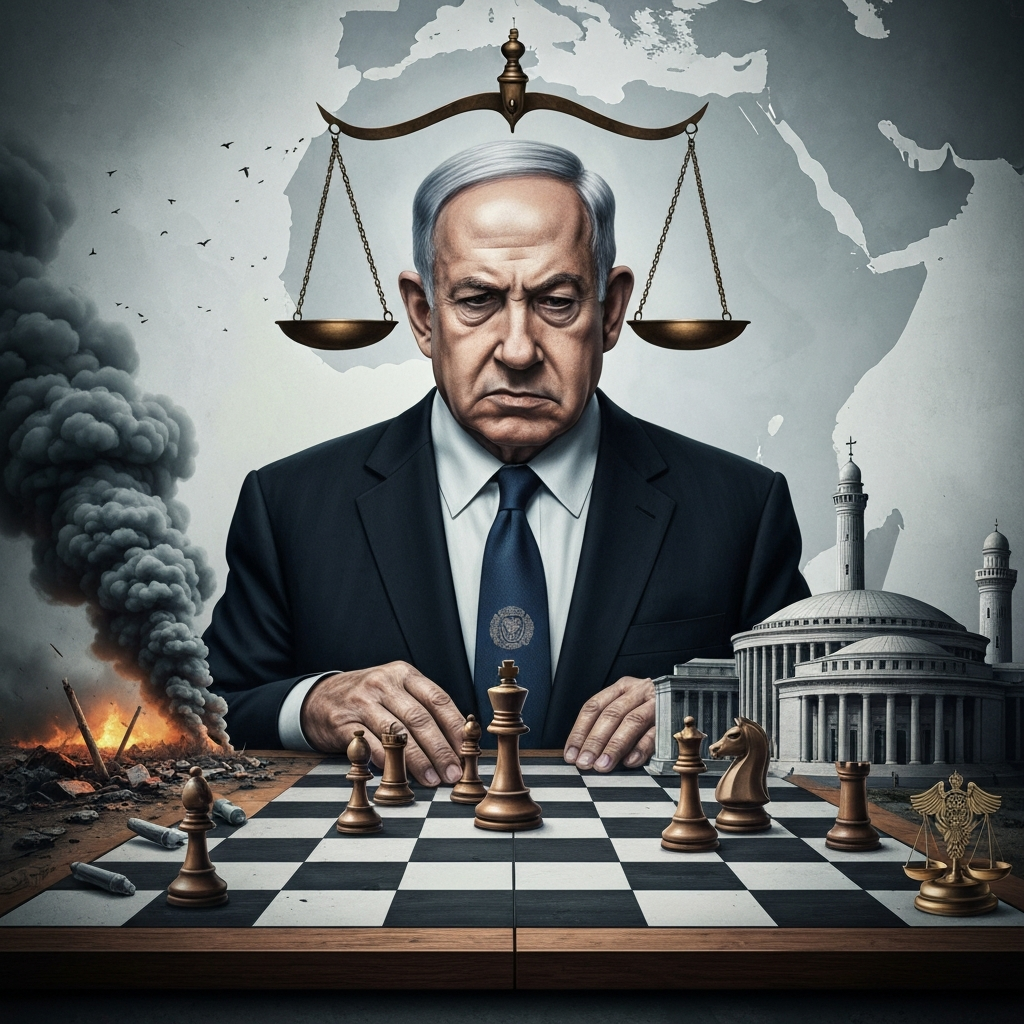
The Strategic Calculus of Benjamin Netanyahu
An analysis of how Benjamin Netanyahu's leadership fused state preservation with political survival amidst the 2023-2026 crisis, and its geopolitical ramifications for Israel.
Listen to this article
Chapters
33 min listen
The Strategic Calculus of Benjamin Netanyahu: State Preservation, Political Survival, and the Geopolitical Ramifications for Israel (2023–2026)
Introduction: The Dual Hypotheses of Leadership in Crisis
The tenure of Israeli Prime Minister Benjamin Netanyahu—the longest-serving premier in the history of the nation—presents one of the most complex geopolitical and political-psychological case studies of the twenty-first century. Following the catastrophic events of October 7, 2023, and the subsequent multi-front regional war that extended deep into 2026, international analysts, legal scholars, and domestic political opponents have intensely debated the core motivations driving his leadership. Much of the international ire generated during this period has been pinpointed directly on Netanyahu. Across global diplomatic forums and within international legal institutions, he has frequently been decried as a war criminal and a power-hungry individual willing to extend agonizing conflicts with Hamas and other regional adversaries with the primary objective of delaying or evading legal recriminations for his own active criminal cases.
This external perception is compounded by systemic deficits in Israel's strategic communications. The Israeli defense and operational task forces (often referred to within localized operational parlance or bureaucratic shorthand as the DTF) have become notorious for not providing timely press office debunking, transparent tactical briefings, or explanatory evidence regarding highly controversial decisions, particularly in terms of dealing with the Palestinian conflict and civilian casualties in the Gaza Strip. This chronic lack of explanatory evidence has allowed international narratives to solidify around the premise that Israel's military actions are disproportionate, punitive, and driven by the political desperation of its leader rather than legitimate security imperatives.
A central premise of the international and domestic critique against Netanyahu is rooted in the intersection of statecraft and legal liability. There is a common political assumption—often drawn from constitutional frameworks in other nations—that a "war president" or a wartime head of government cannot face an active criminal case against him while directing national defense, thereby incentivizing a legally embattled leader to prolong hostilities to maintain de facto immunity. Conversely, Netanyahu's proponents and ideological allies vehemently insist that while his political tactics are frequently unorthodox, ruthless, and occasionally unsavory, his primary, overriding objective remains the absolute preservation and security of the Jewish state in an intrinsically hostile region.
Political psychology dictates that human motivations can be profoundly complex; leaders can act out of one foundational orientation—such as an ideological commitment to national survival—but happen to effectuate another, such as securing their own grip on power. This exhaustive report addresses two fundamental questions regarding the Prime Minister’s administration during the 2023–2026 crisis period. First, has Netanyahu’s primary goal been to preserve the Jewish state? Second, have his actions been proven to serve those ends, or has he done irreparable damage to the country’s reputation, legal standing, and global alliance structures? Through a granular analysis of Israeli domestic policy, the prosecution of the Gaza war, the restructuring of Israel's strategic military doctrine, the trajectory of ongoing corruption trials, and the unprecedented shifts in global diplomacy, this report synthesizes the intricate relationship between state preservation and personal political survival.
The Information War: Strategic Communications and the Deficit of Explanatory Evidence
Before analyzing the geopolitical and military decisions of the Netanyahu government, it is necessary to examine the mechanisms through which these decisions are communicated to the global public. The international ire directed at Israel is not solely a product of the kinetic military actions taken in Gaza and Lebanon, but also a result of a profound failure in public diplomacy and strategic communications. The Israeli defense task forces and specialized operational units have consistently failed to provide the necessary explanatory evidence to contextualize their military operations, particularly when dealing with the densely populated urban environments of the Palestinian territories.
This notoriety for failing to provide immediate press office debunking or transparent evidence has severely crippled Israel's ability to defend its conduct under international law. In modern asymmetric warfare, the narrative battle is often as strategically decisive as the physical battlefield. When hospitals, schools, or refugee camps are struck, the immediate aftermath is characterized by a vacuum of official Israeli explanatory evidence, which is rapidly filled by adversarial narratives, casualty figures provided by local authorities, and condemnation from international non-governmental organizations. Even when the Israeli military eventually releases intelligence suggesting that such civilian infrastructure was being utilized as command-and-control centers or weapons depots by Hamas or other militant factions, the delayed response is frequently dismissed by the international press as post hoc justification rather than credible evidence.
This systemic failure in public diplomacy directly exacerbates the personal condemnation of Benjamin Netanyahu. Because the institutional apparatus fails to adequately explain the tactical necessity or the rules of engagement governing specific operations, the international community logically attributes the devastation to the malicious intent of the top executive. The lack of transparent, real-time debunking allows critics to easily draw a straight line between the immense civilian death toll in Gaza and Netanyahu's personal political requirement to project strength and prolong the conflict. In essence, the informational vacuum created by the defense establishment serves as the fertile ground upon which the accusations of war crimes and political opportunism against Netanyahu are cultivated and sustained across global media platforms.
The Ideological Matrix of State Preservation
To rigorously evaluate whether Netanyahu’s primary goal has been the preservation of the Jewish state, one must first deconstruct his foundational worldview and historical ideology. Netanyahu’s fundamental stance toward the world is characterized by profound, existential mistrust. While he experienced idealistic chapters earlier in his life, his prevailing, hardened view is that human nature is inherently dark and that the geopolitical arena cannot fundamentally improve—especially as it applies to the safety, sovereignty, and survival of the Jewish people.
The Cautionary Tales of Grand Strategy
This deep-seated pessimism serves as a liberating psychological mechanism for his political maneuvering, enabling him to operate freely, tactically, and often ruthlessly across the domestic political spectrum. He makes and spurns allies—secular and religious, centrist and far-right—so long as he remains in control of the state apparatus, which he views as the only reliable guarantor of Jewish survival. Netanyahu is deeply suspicious of grand diplomatic moves and views the pursuit of definitive, transformative peace treaties with Palestinian factions as a naïve and existential hazard. He analyzes the actions of his predecessors through a strict lens of historical failure: Prime Minister Menachem Begin’s ambitious invasion of Lebanon in 1982, Prime Minister Ehud Barak’s final, comprehensive peace offer to Yasser Arafat at Camp David in 2000, and Prime Minister Ariel Sharon’s unilateral military and civilian disengagement from the Gaza Strip in 2005.
In Netanyahu’s assessment, every instance in modern Israeli history where a leader took a substantial strategic risk for peace, attempted to reshape the internal politics of a neighboring entity, or offered sweeping territorial concessions, the result was severe security degradation and an increase in violence. Consequently, his grand strategy has historically been a carefully calibrated mix of long-term caution and tactical audacity. He projects an eloquently bellicose persona to deter adversaries and satisfy his right-wing base, while traditionally striving to keep actual kinetic military action as limited and contained as possible—a doctrine that guided his leadership for over a decade before being entirely upended by the events of October 7, 2023.
Demographic Anxiety and the Nation-State Law
Netanyahu's vision of state preservation is strictly nationalist, territorially focused, and demographic. In his ideological framework, Israel's survival is not merely about maintaining physical security perimeters, but about aggressively defending its exclusive identity as the sovereign homeland of the Jewish people. This ideology was legally codified in the deeply controversial Basic Law: Israel as the Nation-State of the Jewish People, passed under his leadership in 2018. The law explicitly declared that the right to exercise national self-determination within the State of Israel is unique and exclusive to the Jewish people.
When faced with intense domestic and international criticism regarding the status of Israel's Arab minority following the law's passage, Netanyahu publicly doubled down on this exclusionary rhetoric. During a highly publicized exchange in 2019 with Israeli actor Rotem Sela, Netanyahu stated unequivocally that Israel is “not a state of all its citizens”. He clarified his position by arguing that while all citizens, including the roughly 17 percent Arab minority, possess equal individual civil rights and receive government investment, the state entity itself is the nation-state "of the Jewish people—and only it".
Unlike Israel's original 1948 Proclamation of Independence, the Nation-State Law contains no language regarding absolute equality among all inhabitants, a deliberate legislative omission that reflects Netanyahu's prioritization of Jewish demographic and national supremacy as the non-negotiable core of state preservation. A Knesset legal advisor later noted that efforts to include mentions of equality and the state belonging to all its citizens were explicitly rejected by the governing coalition during the drafting process. This ideological framework, which inherently views Palestinian national aspirations as a demographic and security threat to Jewish sovereignty, paved the way for the ultimate political manifestation of this worldview: the July 2024 Knesset resolution. Passed with an overwhelming 68–9 majority, the resolution explicitly rejected the establishment of a Palestinian state on any piece of land west of the Jordan River, officially labeling such a theoretical state an "existential danger" to Israel. For Netanyahu, preventing the realization of a Palestinian state is synonymous with preserving the Jewish state.
The Architecture and Catastrophic Failure of the "Conceptzia"
Before analyzing the prosecution of the post-2023 war and the allegations of political opportunism, it is necessary to examine the security strategy that preceded it. Netanyahu’s approach to the Gaza Strip and the Hamas organization was defined by a widely accepted paradigm within the Israeli defense and intelligence establishment known as the "Conceptzia" (a Hebrew term translating roughly to preconception or institutional groupthink).
The Strategic Logic of Managing Hamas
For several years leading up to the fall of 2023, Netanyahu's government operated under the steadfast belief that Hamas was effectively deterred from undertaking a significant, large-scale attack against Israeli territory. The prevailing intelligence assessment posited that Hamas, having secured control of Gaza, had developed a "growing commitment to governing" the enclave and providing for its civilian population. This belief was not solely Netanyahu's; it was supported and promoted by the highest echelons of the security establishment. In late 2021, during a senior-level Defense Ministry planning meeting, Major General Tamir Hayman, then head of military intelligence, and IDF Chief of Staff Lieutenant General Herzl Halevi concurred that Hamas favored economic arrangements and calm over mass escalation. As late as June 2023, Netanyahu confidently informed political party leaders that he was convinced Hamas was thoroughly deterred.
To sustain this presumed calm and manage the conflict, Netanyahu’s government engaged in a highly controversial policy of economic pacification. Israel actively facilitated, and at times directly coordinated, the transfer of tens of millions of dollars in cash—reportedly around $30 million a month—from the Gulf state of Qatar directly to Hamas in Gaza. These funds were physically transported in suitcases in the back of taxi cabs across the border, with US diplomacy occasionally engaging the Qatari government to ensure the payments were delivered to maintain stability.
The strategic, second-order logic behind this policy was deeply cynical but aligned perfectly with Netanyahu's overarching goal of preventing a Palestinian state. By allowing Hamas to retain power, build its administrative capacities, and distribute modest economic benefits in Gaza, Netanyahu effectively ensured that the Palestinian polity remained geographically, politically, and ideologically divided between the radical Hamas in Gaza and the internationally recognized Palestinian Authority (PA) in the West Bank. A permanently bifurcated Palestinian leadership ensured that there could be no unified, credible diplomatic partner to pressure Israel into returning to the negotiating table for a two-state solution.
| Strategic Pillar of the Conceptzia | Underlying Assumption (Pre-Oct 2023) | Strategic Objective for Israel | Resulting Catastrophic Failure |
|---|---|---|---|
| Economic Pacification | Hamas prioritizes governance, civilian infrastructure, and financial stability over its foundational jihadist ideology. | Maintain calm on the southern border; avoid politically costly ground invasions of Gaza. | Hamas utilized financial resources and the facade of governance to build an extensive subterranean military fortress. |
| Qatari Funding Mechanism | Supervised international financial aid (via Qatar) can be leveraged to buy quiet and manipulate Hamas's behavior. | Prolong periods between conflict outbreaks (a strategy known as "mowing the grass"). | Funding insulated Hamas from popular domestic unrest, allowing its military wing to plan the October 7 massacre undisturbed. |
| Palestinian Political Division | A deeply bifurcated Palestinian leadership (Hamas vs. PA) cannot negotiate or implement a final-status peace treaty. | Neutralize international pressure for a two-state solution and permanently preserve the territorial status quo. | Enabled the radicalization and militarization of Gaza without providing any diplomatic avenues for moderation or reform. |
| Focus on the Iranian Threat | The primary existential threat is the Iranian nuclear program and its advanced proxies (primarily Hezbollah in Lebanon). | Allocate premium intelligence and military resources to the "War Between the Wars" in Syria and Lebanon. | Created a catastrophic intelligence blindness on the Gaza border; resulted in a massive underestimation of Hamas's operational capabilities. |
The Catastrophe of October 7
The "Conceptzia" proved to be a fatal strategic miscalculation. It collapsed spectacularly and tragically on October 7, 2023, when approximately 4,000 Hamas militants breached the sophisticated border fences, resulting in the murder of 1,200 Israelis and the abduction of over 250 hostages into the Gaza Strip. While Netanyahu has fiercely combated reports that he personally ignored direct, last-minute intelligence warnings from Egyptian Intelligence Minister Abbas Kamel regarding a major impending attack, the structural failure of the intelligence apparatus undeniably occurred on his watch.
Proponents of Netanyahu argue that the Conceptzia was an institutional failure of the military and intelligence establishment, pointing out that top generals had repeatedly assured the Prime Minister that Hamas was deterred. During a classified debate in the Foreign Affairs and Defense Committee, Netanyahu presented extensive protocols, security debates, and intelligence reports from the past 12 years to demonstrate that the security branches consistently advocated for maintaining calm and pursuing the "arrangement" policy with Hamas. However, critics and political opponents argue that the overarching policy of deliberately propping up Hamas to weaken the Palestinian Authority was uniquely Netanyahu's geopolitical design. Therefore, they assert he is fundamentally and strategically responsible for cultivating the environment that allowed the October 7 massacre to occur.
The Legal Crucible: The "War President" Paradox and Active Criminal Liability
To address the user's specific query regarding whether Netanyahu extended conflicts with the sole objective of not facing recriminations for his allegedly illegal activity, one must carefully examine the intersection of Israeli constitutional law and the timeline of his ongoing criminal trials. The prompt asserts a common political premise: "Since a war president cannot have active criminal case against him." It is imperative to clarify that under the Basic Laws of Israel, this premise is legally false. Unlike certain executive immunity doctrines found in other jurisdictions (such as the debates surrounding presidential immunity in the United States), Israeli jurisprudence does not grant absolute immunity from prosecution to a sitting Prime Minister, even during a state of war.
The Continuation of Case 4000
Benjamin Netanyahu holds the unprecedented distinction of being the first sitting Israeli Prime Minister to face active criminal prosecution. His trial for bribery, fraud, and breach of trust—collectively encompassing several distinct investigations, most notably Case 4000 involving alleged illicit regulatory favors granted to telecommunications magnate Shaul Elovitch in exchange for positive media coverage—continued aggressively throughout the crisis years of 2024, 2025, and 2026.
Despite the exigent circumstances of a multi-front regional war, the Jerusalem District Court, presided over by a panel of three judges (Rivka Friedman-Feldman, Moshe Bar-Am, and Oded Shaham), maintained the trajectory of the proceedings. After the prosecution finally rested its case in July 2024, the defense phase commenced in December 2024. Netanyahu officially took the stand to testify in his own defense on March 4, 2025. Throughout the spring and summer of 2025, and extending into February 2026, he faced grueling cross-examinations, appearing in court over two dozen times. During his testimonies, he repeatedly and vehemently denied the allegations, famously characterizing the corruption charges against him as an "ocean of absurdity" and occasionally clashing with the presiding judges over courtroom decorum.
The Strategy of Delay and the Pardon Request
While Israeli law does not automatically suspend a trial for a "war president," the practical realities of wartime leadership provided Netanyahu's defense team, led by Amit Hadad and Boaz Ben-Tzur, with substantial leverage to request procedural delays. Throughout late 2024 and 2025, his attorneys filed numerous motions to postpone hearings and delay his cross-examination, citing ongoing diplomatic developments, the requirements of managing military campaigns, and personal health issues, including a minor surgery that resulted in the cancellation of two weeks of hearings in January 2025. The court rejected several of these requests—such as a motion in late 2025 to delay testimony, citing a lack of detailed justification—forcing the Prime Minister to continually balance the demands of statecraft with his personal legal defense.
The profound legal jeopardy Netanyahu faced, and the realization that the judiciary would not halt the trial indefinitely due to the war, culminated in an extraordinary political maneuver. On November 30, 2025, Netanyahu formally submitted a request for a presidential pardon to Israeli President Isaac Herzog. This pardon request was not an isolated domestic event; it was heavily backed, and arguably orchestrated in tandem with, external geopolitical pressure. Returning U.S. President Donald Trump, a staunch ally of Netanyahu, publicly intervened in the Israeli domestic legal process. Trump repeatedly called on President Herzog to pardon Netanyahu, issuing a formal letter in November 2025, and publicly lambasting Herzog in early 2026, calling his refusal to grant the pardon immediately "disgraceful" and asserting that Herzog should be "ashamed of himself".
The Legal Peril of the Inner Circle
Netanyahu's legal vulnerabilities were not limited to his own historic corruption cases. By 2026, his inner circle was increasingly engulfed in legal scandals related to the management of the war itself. His chief of staff, Tzachi Braverman, was investigated on suspicion of interfering with a police investigation and other crimes. These allegations centered on claims that Braverman attempted to quash a military investigation into Eli Feldstein, a spokesperson for Netanyahu, over the illicit leak of highly classified documents to the German newspaper Bild—documents allegedly utilized to manipulate public opinion regarding the stalled hostage negotiations. The Prime Minister dismissed these probes as a malicious "witch hunt" orchestrated by his political critics.
The convergence of these legal crises strongly supports the hypothesis that political survival was a primary driver of his actions. By prolonging the conflict and maintaining a wartime footing, Netanyahu created a political environment where calling for early elections or replacing the Prime Minister was framed as a dangerous dereliction of national security. The war served as a formidable shield against the immediate political consequences of his ongoing trial, even if it did not provide absolute legal immunity.
Strategic Shift: Preemption, the "1948 Mindset," and Munitions Independence
While the legal chronology suggests a leader fighting for his personal survival, an examination of the systemic shifts in Israel's military posture from 2024 to 2026 provides robust evidence for the proponents' argument: that Netanyahu utilized his prolonged time in office to fundamentally enhance the long-term strategic preservation of the Jewish state.
Following the catastrophic failure of the containment doctrine on October 7, the Israeli state fundamentally reconfigured its security posture. Under Netanyahu's leadership, the nation transitioned from a doctrine of conflict management—relying on defensive measures like the Iron Dome and periodic, limited escalations—to a doctrine of active preemption and decisive warfighting. By 2025 and 2026, a new national consensus had emerged across the political spectrum, characterized by opposition leader Benny Gantz as a return to a "1948 mindset". This mindset dictated that terror armies would no longer be permitted to build up along Israel's borders, regardless of international diplomatic pressure.
The Degradation of the Shi'ite Axis
Under Netanyahu’s oversight, the IDF systematically dismantled Hamas’s conventional, organized military capabilities in the Gaza Strip, though the group inevitably morphed into a persistent, decentralized guerrilla insurgency. However, the most significant actions taken for Israel's broader geopolitical security occurred on the northern and eastern fronts against the broader Iranian-led "Shi'ite Axis."
Netanyahu authorized a series of highly audacious, preemptive strikes that crippled Israel's most formidable adversaries. This included the brilliant and devastating "beeper operation" in the fall of 2024 that decimated Hezbollah's tactical communications network, followed rapidly by the assassination of Hezbollah's supreme leader Hasan Nasrallah. As regional instability grew, Israel took advantage of the collapse of the Assad regime in Syria in December 2024 to systematically destroy the Syrian army's remaining strategic capabilities, preventing those weapons from falling into the hands of Iranian proxies.
The culmination of this preemptive doctrine occurred in June 2025, when Israel executed a massive, 12-day direct military operation against the Islamic Republic of Iran. This operation explicitly targeted Iranian nuclear and advanced missile facilities, delivering a critical blow to Tehran’s strategic capabilities and reportedly pushing back its nuclear threshold by several years.
Proponents of Netanyahu point to these extraordinary military achievements as definitive proof that his primary goal is state preservation. They argue that these victories leave Israel in an incomparably stronger regional strategic position than it was on October 6, 2023. Furthermore, they highlight Netanyahu's sheer stubbornness and resilience against immense pressure from the Biden administration—which repeatedly attempted to halt the Gaza war and prevent regional escalation before Israel's military objectives were met—as proof that his ultimate loyalty is to the physical preservation of the state, regardless of the severe diplomatic blowback or his own political popularity.
The Drive for Munitions Independence
A critical third-order insight from the 2023–2026 conflict is Israel's stark realization of its extreme vulnerability to allied supply chains. Throughout the early phases of the war, the United States utilized the resupply of precision munitions as direct diplomatic leverage to constrain Israeli military operations, particularly regarding full-scale invasions of civilian population centers.
In response to this vulnerability, a non-partisan defense report authored by the "Nagel Committee" in January 2025 emphasized that Israel must achieve total independence in producing critical defense weapon systems to avoid dependency on foreign suppliers. Netanyahu enthusiastically adopted this pillar, continuously advocating for and operationalizing a massive national industrial shift toward munitions self-sufficiency. By implementing this policy, Netanyahu aimed to ensure that future Israeli prime ministers would not be bound by foreign political pressure when executing existential defense operations, a move fundamentally aligned with the long-term preservation of state sovereignty.
Coalition Dynamics and the Strategic Paralysis of the Gaza Campaign
The tension between state preservation and personal political survival is most clearly illuminated by examining Netanyahu's management of his domestic coalition and how those political dynamics warped the strategic prosecution of the war in the Gaza Strip.
To avoid political collapse, early elections, and the subsequent acceleration of his criminal trials without the shield of the premiership, Netanyahu required a stable governing coalition. Following the departure of centrist figures from emergency unity governments early in the conflict, his coalition relied fundamentally on far-right, ultranationalist ministers, primarily National Security Minister Itamar Ben-Gvir and Finance Minister Bezalel Smotrich. These actors hold a rigid, messianic ideological vision for the Gaza Strip: the permanent Israeli military occupation of the territory and the re-establishment of Jewish settlements that were dismantled in 2005. At public rallies attended by members of Netanyahu's own Likud party, these factions laid out their vision for new settlement neighborhoods in Gaza, a proposition Netanyahu publicly called "unrealistic" but practically enabled through his policy decisions.
The Rejection of the "Day After" Strategy
This domestic political architecture profoundly paralyzed Israel's military strategy. According to standard counterinsurgency doctrine, defeating an embedded group like Hamas requires not just military force, but the introduction of a viable, alternative governing structure to replace them. By early 2024, Defense Minister Yoav Gallant explicitly and publicly challenged Netanyahu on this issue. Gallant noted that the military and security establishment had prepared detailed plans for the "day after" in Gaza, which required empowering a reformed Palestinian Authority, or a coalition of local technocrats backed by moderate Arab states, to assume civilian administration of the enclave.
Netanyahu categorically rejected these plans. He famously ruled out the Palestinian Authority in any form as a partner for governing Gaza and adamantly refused to deliberate any other realistic alternatives. This refusal was not necessarily driven by sound strategic logic, but by political survival: accepting the Palestinian Authority into Gaza would instantly cause Ben-Gvir and Smotrich to collapse the government, leading to new elections that polls consistently showed Netanyahu would lose.
By refusing to articulate a realistic political endgame, Netanyahu guaranteed the indefinite continuation of the war. Without an alternative governing structure, Hamas was able to continuously reconstitute itself in areas the IDF had previously cleared, forcing the military into an endless, grinding cycle of operations.
The Hostage Crisis and the Delay of Negotiations
The subordination of strategic endgames to coalition survival had devastating consequences for the Israeli hostages held by Hamas. Critics, political analysts, and the Hostages and Missing Families Forum consistently argued that Netanyahu deliberately sabotaged, or placed impossible conditions on, phased ceasefire deals because ending the war would fracture his far-right coalition. Polling indicated that a significant portion of the Israeli public—49 percent in some surveys—believed his insistence on certain terms during negotiations was driven entirely by political reasons rather than security imperatives.
The human cost of this strategic paralysis was severe. Former hostages, such as Eli Sharabi, detailed the psychological torment of captives like Alon Ohel, who were informed by their captors of phased release deals, only to be left behind in subterranean tunnels when negotiations inevitably collapsed due to hardened demands from both Hamas and the Israeli government. In rare media appearances, Netanyahu furiously rejected the claim that he was needlessly prolonging the war for personal gain, calling the accusation "malicious and false". He justified the timeline by comparing the urban combat in Gaza to the US-led battle for Fallujah in Iraq, noting that Fallujah took nine months against a fraction of the combatants in a far less complex subterranean environment, arguing that the IDF was acting with unprecedented efficiency under the circumstances.
Nevertheless, the reality remained: achieving the dual, maximalist goals of returning all hostages alive and completely eradicating Hamas militarily proved contradictory. The insistence on total victory without a political off-ramp prolonged the suffering of the hostages and the civilian population of Gaza, serving the immediate political stability of the Netanyahu government while arguably damaging the social fabric of the state.
Irreparable Damage: International Law, Reputation, and Global Pariah Status
To answer the second portion of the user's query—whether his actions have proven to serve the ends of preserving the Jewish state or if he has done irreparable damage to the country's reputation—one must analyze the catastrophic collapse of Israel's standing in the international community. While Netanyahu's proponents point to the tactical degradation of regional adversaries as proof of success, the mechanisms utilized to achieve these goals have resulted in historically unprecedented legal and diplomatic isolation.
The Humanitarian Catastrophe in Gaza
The sheer scale of kinetic destruction in the Gaza Strip fundamentally altered global perceptions of the Israeli state. By late 2025, the estimate of Palestinians killed exceeded 70,000—representing more than 3 percent of the enclave's pre-war population—with an estimated 171,000 individuals severely wounded. The volume of casualties was staggering, and leaked Israeli military estimates suggested that non-combatant civilians comprised up to 83 percent of the total fatalities.
Furthermore, satellite data and comprehensive United Nations assessments indicated that approximately 92 percent of Gaza’s residential buildings, alongside the vast majority of its educational, medical, and religious infrastructure, were damaged or completely destroyed. Major international organizations, including Amnesty International and Human Rights Watch, documented systemic violations, reporting that the Israeli military targeted civilian infrastructure, utilized the impediment of food and water as a form of collective punishment, and engaged in widespread abuse and torture of Palestinian detainees, resulting in nearly a hundred recorded deaths in custody by November 2025. A team of independent experts commissioned by the UN Human Rights Council went as far as concluding that Israel was committing acts of genocide in Gaza.
The ICC Arrest Warrants
The most concrete and historically damaging manifestation of this reputational collapse occurred in May 2024, when the International Criminal Court (ICC) took the unprecedented step of issuing formal arrest warrants for Prime Minister Benjamin Netanyahu and Defense Minister Yoav Gallant. ICC Chief Prosecutor Karim Khan argued that there were reasonable grounds to believe both men bore direct criminal responsibility as co-perpetrators for the war crime of starvation as a method of warfare, and for crimes against humanity, including murder, persecution, and intentionally directing attacks against civilian populations.
The issuance of these warrants was a watershed moment in international legal history. It officially designated the sitting Israeli Prime Minister as a wanted man across the 124 member states that are party to the Rome Statute. This action severely restricted the diplomatic mobility of Israeli leadership and shattered the long-held assumption that Western-aligned democratic leaders were immune from international tribunals. Netanyahu furiously dismissed the warrants as a corrupt, antisemitic attack on democracies trying to defend themselves from terrorism, but the legal stain remained indelible.
Global Isolation and the Erosion of the American Alliance
Israel's isolation within traditional multilateral institutions reached its zenith during this period. Israel, a state created through a UN mandate, found itself perpetually in conflict with the organization. In September 2024, the UN General Assembly passed a sweeping resolution demanding Israel comply with international law, end its occupation of Palestinian territories, and dismantle the separation wall; the resolution passed with an overwhelming 124 nations in favor and only 14 against.
In response to the diplomatic vacuum and the devastation in Gaza, a global wave of unilateral recognitions of Palestinian statehood occurred. By 2026, 145 countries formally recognized the State of Palestine, including 19 nations (15 of which were European allies) that granted recognition in 2024 and 2025 alone. Israel, historically shielded by a solid Western consensus, now faced a hostile global environment where academic, cultural, and economic boycotts rapidly moved from the activist fringes into mainstream corporate and institutional policy.
Perhaps the most dangerous strategic damage to the long-term preservation of the Jewish state was the severe erosion of its alliance with the United States public. For decades, bipartisan support in the U.S. was the ultimate bedrock of Israeli national security, guaranteeing diplomatic vetoes at the UN Security Council and billions in advanced military aid. However, by 2025, public opinion had shifted dramatically. According to comprehensive Pew Research data, 53 percent of U.S. adults reported a negative attitude toward Israel, a significant and rapid increase from 42 percent in just 2022. Confidence in Netanyahu specifically plummeted globally; overwhelming majorities in allied nations—including Australia, France, Germany, and the UK—expressed little to no confidence in his leadership. By alienating the younger demographic and heavily fracturing the electoral bases of both major U.S. political parties, Netanyahu's policies fundamentally compromised the primary diplomatic pillar of Israel's geopolitical survival.
| Indicator of Global Standing | Pre-War Status (2022) | Post-War Status (2025/2026) | Strategic Implication |
|---|---|---|---|
| US Public Opinion | 42% Negative Attitude | 53% Negative Attitude | Erosion of the reliable bipartisan consensus essential for US military/diplomatic aid. |
| International Legal Status | Protected by domestic judicial independence | Prime Minister indicted by the ICC for war crimes | Severe restriction on diplomatic mobility; sets precedent for sanctions and embargos. |
| UN General Assembly | Routine condemnation | 124-14 vote demanding end of occupation | Near-total isolation in multilateral forums; delegitimization of Israeli territorial claims. |
| Statehood Recognition | Stalled recognition among Western states | 145 countries recognize Palestine (19 new in 24/25) | Diplomatic failure of Netanyahu's core objective to prevent international acceptance of a Palestinian state. |
The "Board of Peace" and the Reconfiguration of Regional Diplomacy
Recognizing the total collapse of the traditional peace process, the paralysis of the United Nations, and the immense pressure to stabilize the region, the international community, led by a newly inaugurated U.S. President Donald Trump, attempted a radical reconfiguration of the conflict architecture in early 2026.
Bypassing the UN and the Palestinian Authority
On February 19, 2026, President Trump hosted the inaugural meeting of the "Board of Peace" in Washington, D.C.. Framed as a mechanism to oversee the massive reconstruction of Gaza and presented as a new international tool for conflict stabilization, the Board effectively bypassed traditional UN structures, drawing intense criticism from European allies and UN officials who viewed it as undermining the rules-based international order. The initiative assembled a highly transactional coalition of Gulf and Central Asian states—including the UAE, Saudi Arabia, Qatar, Kazakhstan, and Uzbekistan—who, alongside the U.S., pledged an initial $17 billion toward Gaza's reconstruction.
The structural design of the Board of Peace heavily reflects the political preferences of the Netanyahu government and the strategic ambiguity of the Trump administration. It mandates that daily operations in Gaza be handled by a "National Committee for the Administration of Gaza" (NCAG), composed of 15 Palestinian technocrats. Crucially, this structure strictly excludes the remaining Hamas factions, but it also intentionally sidelines the internationally recognized Palestinian Authority, treating Palestinians as recipients of aid and administrative management rather than sovereign authors of their own destiny. The Board's executive committee incorporates international figures like former British Prime Minister Tony Blair and former U.S. advisor Jared Kushner, utilizing a donor-led model rather than a human-rights-based or political framework.
Enabling Annexation and Strategic Isolation
While the Board of Peace offers a massive financial mechanism to fund the rebuilding of Gaza, international critics argue it represents a profound diplomatic victory for Netanyahu's lifelong strategy of conflict management over conflict resolution. By sidelining the Palestinian Authority and failing to explicitly tie the reconstruction efforts to a timeline for Palestinian statehood, the initiative allows the Israeli government to maintain a significant, indefinite military and security footprint over the territory.
Furthermore, by focusing the entirety of international diplomatic attention on Gaza's technocratic management, the Board provided essential cover for the Netanyahu coalition's activities in the West Bank. In December 2025, just weeks before the Board convened, the Israeli Cabinet quietly approved 19 new Jewish settlements in the occupied West Bank, a move that further eroded the physical viability of a contiguous Palestinian state.
However, this highly transactional approach to diplomacy comes at the cost of genuine regional integration. Saudi Crown Prince Mohammed bin Salman has consistently rebuffed pressure from the U.S. to formally normalize relations with Israel without concrete, irreversible progress toward Palestinian statehood—a concession Netanyahu's ideological coalition will never permit. Consequently, Israel remains regionally isolated, reliant entirely on a single, highly transactional U.S. administration, while the broader global community views the state through the deeply damaging lens of ICC indictments and relentless UN condemnation.
Synthesis and Conclusion: The Fusion of Preservation and Survival
The complex calculus of Benjamin Netanyahu’s leadership from the intelligence failures of 2023 through the regional wars of 2026 demonstrates that the dichotomy between state preservation and personal political survival is, in many respects, a false one. In Netanyahu's deeply ingrained psychological and strategic framework, the two concepts are entirely fused.
Has Netanyahu’s primary goal been to preserve the Jewish state? The evidence indicates that state preservation is indeed his foundational ideological goal, but his definition of preservation is uniquely egocentric, territorially maximalist, and ideologically rigid. He genuinely perceives the international arena as a hostile theater intent on Jewish destruction, and he believes, with profound conviction, that only his specific leadership, historical awareness, and strategic caution can navigate the state through these existential threats. Therefore, actions taken to preserve his own political life—including delaying his criminal trials, attempting to alter the judiciary to protect himself from appellate review, and accommodating far-right extremists to avoid early elections—are justified in his own mind as necessary prerequisites for keeping the "correct" leadership at the helm of the state. His ideological commitment to Jewish demographic and territorial supremacy between the Jordan River and the Mediterranean Sea, as codified in the 2018 Nation-State Law and the 2024 Knesset resolution, dictates a state-preservation model that necessitates the permanent subjugation of Palestinian national aspirations. To Netanyahu, ensuring he remains Prime Minister is synonymous with ensuring the survival of Israel.
Have his actions been proven to serve those ends, or has he done irreparable damage to the country’s reputation? The outcomes of his policies are paradoxically split between undeniable tactical military triumph and catastrophic, strategic diplomatic devastation. Militarily, Netanyahu oversaw a radical and highly successful shift toward a doctrine of preemption. By degrading the organized military structures of Hamas, decapitating the leadership of Hezbollah, executing unprecedented strikes against Iran's nuclear and missile infrastructure, and initiating a national drive toward munitions self-sufficiency, he objectively strengthened Israel's physical security borders. Proponents correctly argue that he restored a deterrent posture that had completely collapsed on October 7, leaving Israel's enemies drastically weakened.
However, the cost of these tactical victories is an incalculable, and arguably irreparable, degradation of the state’s long-term strategic and moral position in the world. The sheer brutality and staggering civilian death toll of the Gaza campaign, driven in large part by his political refusal to articulate a political "day after" strategy that might fracture his governing coalition, resulted in an unprecedented humanitarian catastrophe. This catastrophe, exacerbated by the Israeli defense establishment's chronic inability to provide timely explanatory evidence for its actions, triggered the ultimate mechanisms of international law.
By becoming the subject of ICC arrest warrants, Netanyahu has officially categorized himself—and by extension, the highest levels of Israeli leadership—as international pariahs. By prioritizing his immediate coalition survival over a credible diplomatic horizon, Netanyahu fractured the vital bipartisan consensus in the United States, alienated an entire generation of Western youth, stalled historic regional normalization efforts with the Arab world, and isolated Israel at the United Nations to an unprecedented degree. Ultimately, Benjamin Netanyahu may have successfully secured the physical, military fortress of the Jewish state for the immediate future, but he has deeply, and perhaps permanently, compromised its international legitimacy, its moral standing, and the vital global alliance structures required to sustain it in the decades to come.